
10% OFF Storewide – Automatically applied at Checkout
Quick answer
A rechargeable table lamp runs on an internal battery, so it can sit anywhere without a nearby socket and move between rooms as needed. A plug-in lamp draws mains power continuously, which suits a fixed spot beside a bed or sofa. The right choice comes down to where you want light and how often that spot changes.
Last reviewed: November 2026
Key takeaways
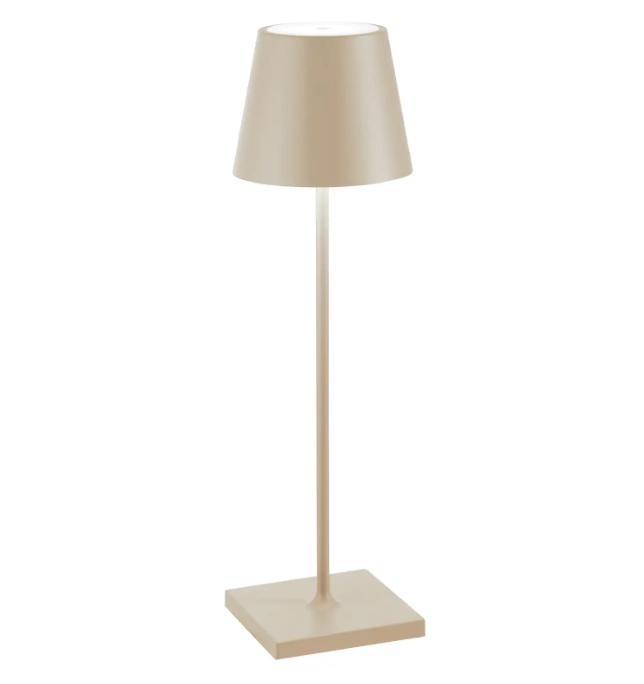
The difference is the power source, and everything else follows from it. A plug-in lamp is tethered to a socket by a cable, so its position is decided by your wiring. A rechargeable lamp holds its own charge and lights up wherever you set it down, then returns to a base or USB cable when the battery runs low.
For a fixed reading nook or a desk that never moves, a cable is a non-issue. The moment you want light on a dining table with no floor socket, a balcony, or a shelf across the room from the nearest outlet, the cordless option is the one that works without an extension lead or a visible trailing wire.
Condos and HDB flats rarely place power points where you actually want a lamp. Sockets sit low on the wall, dining tables float in the middle of open-plan living areas, and balconies often have no weather-rated outlet at all. This is where cordless design earns its place. A lamp that moves with the moment, from the dinner table to the terrace to the bedside, solves a layout problem that a plug-in model cannot.
Plug-in lamps still hold their ground for permanent stations. A desk lamp for long working hours, or a fixed floor lamp beside an armchair, never needs a thought about charging. If the light lives in one spot and stays there, mains power is the simpler answer.
| Consideration | Rechargeable table lamp | Plug-in table lamp |
|---|---|---|
| Placement | Anywhere, no socket needed | Limited to reach of a cable and outlet |
| Portability | Moves room to room, indoors to outdoors | Effectively fixed once positioned |
| Outdoor use | Available on IP-rated models (Poldina IP65, Troll IP54) | Rarely rated for outdoor or wet zones |
| Ongoing input | Needs recharging between uses | Never needs charging |
| Runtime | Battery-limited, roughly 12 to 90 hours depending on model | Unlimited while plugged in |
| Cable visibility | None in use | Visible unless concealed |
| Best for | Dining, terraces, flexible layouts, entertaining | Desks, fixed reading corners, permanent stations |
Runtime depends on the model and the brightness you use it at, and the range is wider than most people expect. The Zafferano Poldina Table Lamp gives around 12 hours at full brightness, 18 to 28 hours at the softer ambient level suited to dining, and closer to 48 hours at its minimum setting. A Sompex Troll runs up to 96 hours, and a Villeroy & Boch Bergamo up to 90 hours at its lowest output. In practice, dimming the lamp for ambience extends a single charge considerably, which is why most evenings never come close to draining the battery.
If your worry is running out mid-dinner, choose a model with generous runtime and keep it topped up between uses. For a fuller breakdown, our battery life and care guide covers how to get the most from each charge.
Not for the settings a table lamp is designed to serve. Cordless models are built for ambient and task light rather than lighting an entire room from a single fixture. The Poldina Table Lamp delivers 234 to 256 lumens across its brightness levels, and a Sompex Troll around 230 lumens, which is ample for a dining table, a bedside, or a reading spot. If you need a floor lamp to anchor a larger space, the Poldina XXL reaches 470 to 500 lumens while staying entirely cordless. Our cordless floor lamp guide covers that end of the range.
Cordless design solves a placement problem, but it does not make plug-in lamps obsolete. There are settings where mains power is genuinely the better fit. A study desk used for long stretches every day benefits from a light that never needs a thought about charge level. A permanent floor lamp beside a favourite armchair, positioned once and left, has no reason to be portable. And any spot with a socket already close by, and no intention of moving the lamp, loses little by staying corded.
The clearest way to decide is to ask a single question about each lamp you are buying: does this light need to move? If the honest answer is no, either type works and other factors, such as design and price, can lead the decision. If the answer is yes, even occasionally, cordless is the option that will not frustrate you later.
It can. A cordless lamp is designed as a complete object, with no cable to route or hide, so it reads cleanly from every angle, including across an open-plan room where the back of a lamp is on show. That freedom is part of why designers reach for cordless models on dining tables and shelves, where a trailing wire would undercut the setting. A plug-in lamp is not lesser for having a cable, but it does ask you to think about where that cable runs and how visible it is. On a side table against a wall, that is easily managed. In the middle of a room, it decides the arrangement for you.
For ambient and task lighting they are equal in quality and, for flexible spaces, more practical. The main trade-off is that a rechargeable lamp needs charging between uses, while a plug-in model runs indefinitely from the wall. Choose based on whether your light needs to move.
Many can, provided they carry an IP rating. The Poldina Table Lamp is IP65 and the Sompex Troll is IP54, both suited to covered terraces and balconies. Indoor-only models such as the Zafferano Angelina should stay inside. Always check the IP rating before placing a lamp outside.
No. Both types use efficient LED sources and the electricity cost is minimal either way. The decision is about placement and flexibility rather than running cost.