
10% OFF Storewide – Automatically applied at Checkout
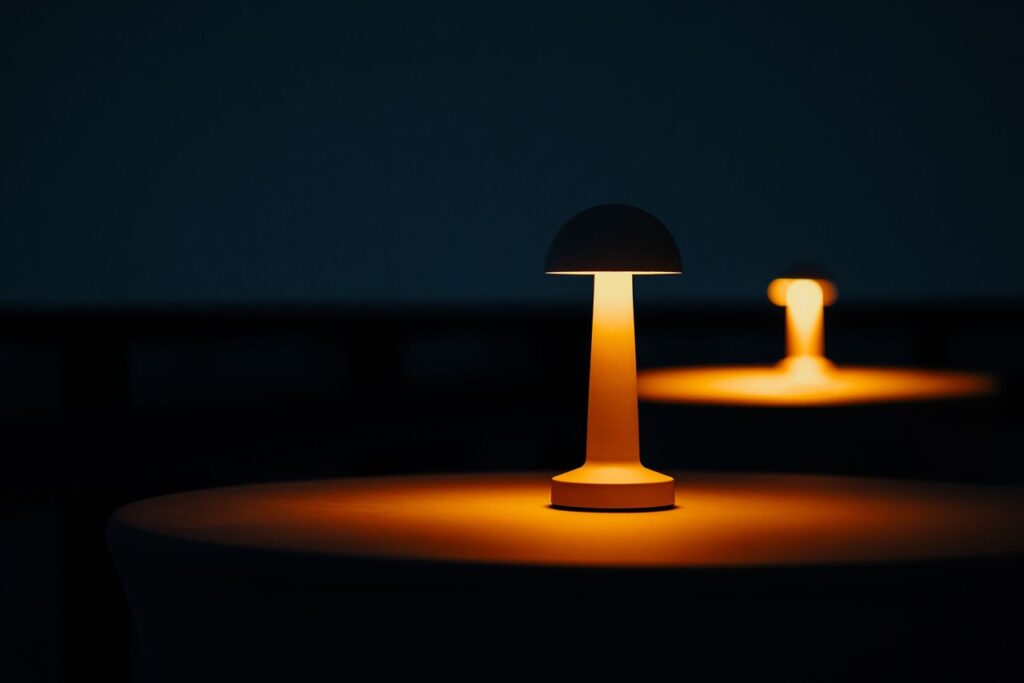
Quick answer
Colour temperature is measured in Kelvin (K). Lower numbers are warmer and more amber; higher numbers are cooler and bluer. For homes, stay in the warm-white band: 2200K for candlelit ambience, 2700K for living rooms and bedrooms, 3000K for dining and kitchen task light. Cool white (4000K and above) belongs in work zones, not living spaces. A lamp with adjustable colour temperature — and a dimmer — lets one fixture cover all of these.
Last reviewed: November 2026
Two lamps can have the same brightness, the same shade, the same price — and make a room feel completely different. The variable that separates them is colour temperature: the warmth or coolness of the light itself, measured in Kelvin. It is the single specification most people skip when buying a lamp, and the one most responsible for whether a room reads as a home or a waiting room.
In Singapore, where the dominant residential direction in 2026 is warm minimalism, getting Kelvin right matters more than ever. A ceiling full of 4000K downlights and a soft 2700K table lamp are not interchangeable. They serve different purposes at different times of day. This guide explains what the numbers mean, where each one belongs, and why a lamp that lets you choose between 2200K, 2700K and 3000K is worth more than one fixed to a single setting.
Colour temperature describes the appearance of a light source — how warm (amber) or cool (blue) it looks — and it is measured in Kelvin (K), the same scale used for absolute temperature. The name is literal: it refers to the colour a piece of metal glows as it is heated. A low-temperature glow is deep amber; a very high one shifts toward cool blue-white. Counterintuitively, lower Kelvin numbers look warmer to the eye, and higher numbers look cooler.
For a lamp, this is the difference between candlelight and a hospital corridor. A candle flame sits at roughly 1800K. A traditional incandescent bulb glows at around 2700K. Midday daylight is closer to 5500K–6500K. The number on the box is telling you, in a single figure, where on that amber-to-blue scale the light will fall.
“Colour temperature is the appearance of the light, not its brightness. A lamp can be dim and cool, or bright and warm. The two are independent — which is why the Kelvin figure deserves as much attention as the lumens.”
One more distinction worth keeping separate: colour temperature is not the same as colour rendering. Colour temperature is the tint of the light; the Colour Rendering Index (CRI) is how accurately that light shows the true colours of objects under it. A good residential lamp pairs a warm colour temperature with a high CRI so skin tones, timber, and fabric all look natural. This guide is about the first of those two — the Kelvin number.
Most quality residential lighting lives within a narrow band between 2200K and 3000K. Here is what each common figure looks like and where it earns its place.
| Kelvin | Appearance | Best for |
|---|---|---|
| 2200K | Deep amber — candlelight, close to a low-burning flame | Late-evening ambience, dinner settings, bar and lounge corners |
| 2700K | Warm white — the classic incandescent glow | Living rooms, bedrooms, reading nooks, general home ambience |
| 3000K | Soft warm white — slightly crisper, still warm | Dining tables, kitchen islands, vanities, task surfaces in living spaces |
| 4000K | Neutral / cool white — daylight-leaning | Kitchens (work prep), study desks, bathrooms, utility areas |
| 5000K+ | Cool daylight — blue-leaning, clinical | Garages, workshops, detailed close work — rarely a living space |
The takeaway is simple. Everything from 2200K to 3000K is warm white and suited to living. Everything from 4000K up is cool white and suited to working. The middle of that scale — 2700K and 3000K — is where most homes should spend their evenings.
Warm white vs cool white is the choice that determines whether a room feels relaxing or alert. Warm white (2200K–3000K) is amber-leaning, easy on the eye, and signals to the body that the day is winding down. Cool white (4000K and above) is blue-leaning, sharpens contrast and detail, and keeps you mentally switched on. Neither is better in the abstract — they are tools for different jobs.
The reason warm white suits homes is partly biological. Cooler, blue-rich light in the evening suppresses the body’s natural wind-down. Warm white, by contrast, mirrors the amber tones of sunset and firelight that humans have relaxed by for millennia. In a bedroom or living room after dark, warm white is not a style preference — it is the light the space is asking for.
“Cool white keeps you alert; warm white lets you settle. The mistake most Singapore homes make is lighting their living rooms with the same 4000K light an office uses — then wondering why the room never feels restful at night.”
This is the most common lighting error in Singapore interiors: a renovation defaults to 4000K recessed downlights throughout, including the living and dining zones. The light is clean and even, but it reads as a showroom rather than a home. The correction does not require rewiring. A portable lamp at 2700K, placed at table or floor level, shifts the perceived warmth of the entire room downward — toward the furniture, toward you.
2700K and 3000K sit only 300 Kelvin apart, yet they do distinctly different work. 2700K is the warmer of the two — the colour of a traditional incandescent bulb, deeply relaxing, ideal for ambience and rest. 3000K is marginally crisper and brighter to the eye while staying firmly in the warm-white family — better where you need to see clearly without losing warmth.
In practice: 2700K is your living room and bedroom baseline, the light you read and unwind by. 3000K is your dining table and kitchen island, where food should look appetising and you still want to see what you are doing. The difference is small but real — set a dining table at 2700K and the food can look slightly muddy; at 3000K it reads clean and fresh while the room stays warm.
2700K vs 3000K — the quick rule
Use 2700K wherever rest is the goal (living room, bedroom, lounge). Use 3000K wherever you need to see clearly but still want warmth (dining table, kitchen island, vanity). When in doubt, a lamp that offers both — switchable in one tap — removes the decision entirely.
This is precisely where adjustable colour temperature earns its keep. Rather than committing one fixed lamp to one room’s purpose, a single lamp that moves between 2200K, 2700K and 3000K adapts as the evening — and the room’s use — changes. The same lamp that sets a 3000K dining table at 8pm becomes a 2200K lounge glow by 11pm.
Colour temperature should follow function, not a single house-wide setting. Here is the room-by-room logic for a Singapore home.
Dining light should make food look its best and frame the table as the focal point. 3000K for the working part of the meal — serving, seeing the plate — easing down to 2200K as the evening softens and the conversation lingers. A cordless lamp on the table itself, rather than a fixed pendant, lets the light follow the dinner when it moves to the terrace.
2700K is the bedroom default — the warmest practical setting for relaxing without straining to read. Avoid anything at 4000K or above near the bed; cool light close to sleep works against you. A bedside lamp that dims deeply at 2700K, or drops to 2200K for a final chapter before lights-out, is the right tool.
Outdoor dining and terrace settings call for warmth that holds its own against the dark — 2700K is the natural choice, dropping to 2200K for candlelit atmosphere. The practical constraint outdoors is not Kelvin but resilience: the lamp needs a real IP rating for Singapore humidity and the occasional spray of rain, and it needs to run without a cable across the threshold.
For pure atmosphere — the glow on a shelf, the warm pool in a corner, the low light that says the day is done — 2200K is the most evocative setting. It is the closest LED equivalent to candlelight, and on a dimmer it is the most flattering light in the home. This is the layer that turns a lit room into a designed one.
“Match the Kelvin to the moment, not the building. A dining table wants 3000K while you eat and 2200K once the plates are cleared. A lamp that holds all three warm settings — and dims across them — is the difference between a fixture and an instrument.”
The best residential light does two things at once: it is warm, and it is dimmable. Brightness and colour temperature are separate controls, but they work together to set a room’s mood. A bright 3000K is right for a working dinner; a dimmed 2200K is right for the hour after. Without a dimmer, you are stuck at one intensity all evening — which is why a fixed downlight, however warm, can never fully relax a room.
A genuinely dimmable warm lamp lets a single fixture span the whole evening. You set the brightness high and the colour at 3000K to lay the table, then ease both down as the night goes on. The room changes character with the hour, the way good light should. This is the case for portable lamps over fixed infrastructure for the ambient and accent layers: the controls are on the lamp, in your hand, adjustable in real time — not on a wall switch decided at renovation.
If you are building a full lighting scheme around this principle, our guide to how to layer light in a Singapore home covers how warm, dimmable lamps work across ambient, task and accent layers without a single hole in a wall.
The reason adjustable colour temperature has become standard in premium portable lighting is that one lamp now has to do several jobs. A cordless lamp moves between rooms and moments — the dining table tonight, the bedside tomorrow, the terrace at the weekend — and each of those wants a different Kelvin. A fixed-temperature lamp forces a compromise. An adjustable one does not.
Zafferano’s Poldina range is the clearest example in the Luxe Lights catalogue. The standard Poldina table lamp cycles through three colour temperatures — 2200K, 2700K and 3000K — across three brightness levels (234 / 251 / 256 lumens), all controlled by a touch sensor at the base. Its aluminium body carries an IP65 rating, so it holds up to covered-terrace conditions, and it runs roughly 12 hours at full brightness, considerably longer at the lower ambient settings used for dining. One lamp, every warm setting, no cable.
Worth a note on bulbs as well as lamps: if you own a transparent or open-frame fixture where the bulb itself is on show, the warm-white principle applies there too. Sompex’s decorative LED bulbs run in the warm range — typically around 2200K for that low, amber, vintage-style glow — and are the warm-end choice when the bulb is the design feature rather than a hidden light source.
For a fuller comparison of which portable models suit which room, our guide to the best rechargeable table lamps in Singapore for 2026 sets out the options side by side, including battery life, IP rating and dimming behaviour. You can also see the European brands behind these lamps on the Luxe Lights brand pages.
Colour temperature describes how warm or cool a lamp’s light appears, measured in Kelvin (K). Lower numbers (around 2200K) look warm and amber, like candlelight; higher numbers (4000K and above) look cool and blue, like daylight. It is separate from brightness — a lamp can be dim and cool, or bright and warm. For living spaces, a warm colour temperature between 2200K and 3000K is almost always the right choice.
Warm white (2200K–3000K) is amber-leaning, relaxing, and suited to living rooms, bedrooms, dining and outdoor ambience — it signals the body to wind down. Cool white (4000K and above) is blue-leaning, sharpens detail, and keeps you alert, which suits kitchens, study desks, bathrooms and work areas. The common mistake in Singapore homes is using cool white throughout, including living zones, which leaves the space feeling like an office at night.
Both are warm white and only 300 Kelvin apart, but they do different jobs. Choose 2700K for rest and ambience — living rooms, bedrooms, lounge corners — where it gives the classic relaxing incandescent glow. Choose 3000K for dining tables, kitchen islands and vanities, where it stays warm but is crisp enough to see clearly and make food look fresh. If you can’t decide, a lamp that switches between both removes the need to commit.
3000K while you serve and eat — it keeps food looking appetising and the table clearly lit — easing down to around 2200K once the meal settles into conversation, for a candlelit feel. A cordless lamp with adjustable colour temperature, such as the Zafferano Poldina, lets you make that shift in a single tap without leaving the table, and moves with the dinner if it carries on to the terrace.
2200K is a deep amber glow, the closest LED equivalent to candlelight. It is the most atmospheric warm-white setting — ideal for late-evening ambience, dinner once the plates are cleared, bar and lounge corners, and accent light on a shelf or in a corner. It is too low for reading or detailed tasks, which is why an adjustable lamp that also offers 2700K and 3000K is more versatile than one fixed at 2200K alone.
Because one lamp can then cover several rooms and moments. A portable lamp that moves between 2200K, 2700K and 3000K — paired with a dimmer — can light a dining table, then a bedside, then a terrace, each at the right warmth, without owning three separate fixtures. Adjustable colour temperature is now standard in premium cordless lamps like the Zafferano Poldina precisely because a lamp that travels needs to suit wherever it lands.
Colour temperature is the quiet specification that decides how a room feels. Stay in the warm-white band — 2200K for ambience, 2700K for living and resting, 3000K for dining and task — and a Singapore home reads as warm, considered and lived-in rather than clinical. Reserve cool white for the kitchen counter and the study desk, where alertness matters more than atmosphere.
The most practical way to apply all of this is not to buy a different lamp for every room, but to choose lamps that adjust. A warm, dimmable, colour-temperature-adjustable cordless lamp covers the whole evening and follows the moment from room to room. Decide the Kelvin you want for the mood; let the lamp give you the rest.
Find your warm-white lamp
Every lamp in this guide is available at Luxe Lights — Singapore’s authorised retailer for Zafferano and Sompex. Visit us at Takashimaya B1, Orchard Road, or browse the full collection online.