
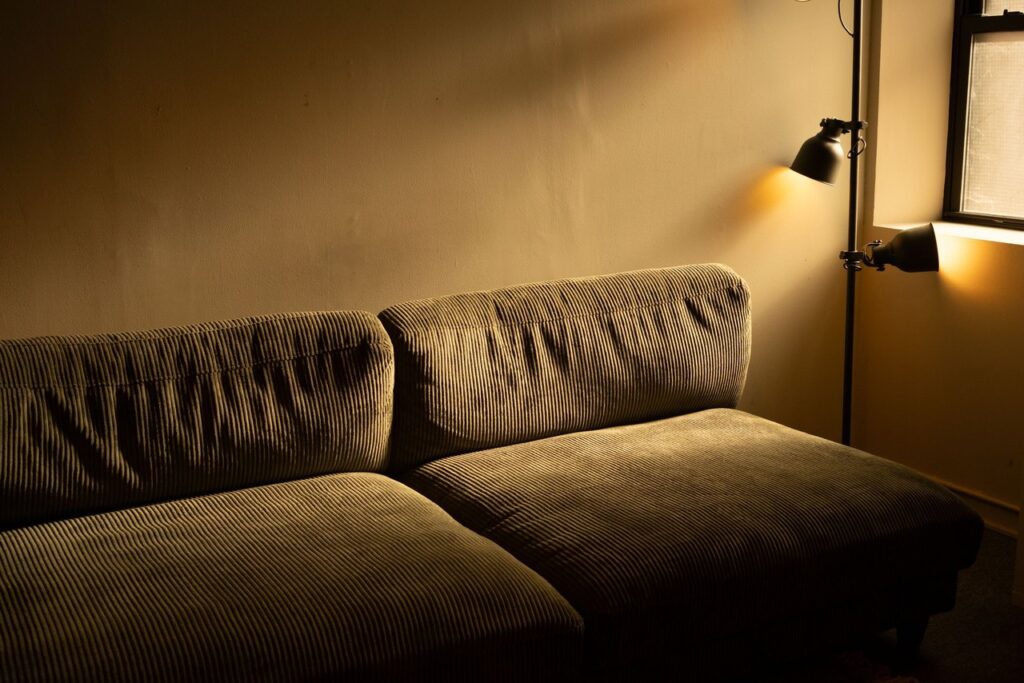
Singapore is in the middle of a renovation wave. In 2026 alone, HDB has projected 13,480 flats reaching their Minimum Occupation Period — each one a candidate for a fresh interior. And yet, the single most common mistake in these renovations is one of the cheapest to make: a single row of recessed downlights, and nothing else.
It’s the default. The ID recommends it. The electrician installs it. And then the homeowner moves in and wonders why the room feels flat — why it looks like an office at 8pm.
Layered lighting is the answer. It’s the highest-ROI single design decision you can make in a Singapore home. Not the tiles. Not the cabinetry. The light. Three layers, all achievable without touching your ceiling, all achievable with portable lamps you can move, reposition, and take with you when you sell.
What Is Layered Lighting — and Why Singapore Homes Need It
Layered lighting means using three distinct types of light in a single room: ambient (the foundational layer that fills the space), task (directed light where you work, read, or eat), and accent (decorative light that creates visual depth and interest). Together, they make a room feel dimensional rather than flat. Most Singapore homes have one layer. The well-designed ones have all three.
Singapore’s open-plan condo layouts — the combined living-dining zone, the kitchen island that bleeds into the living area — are particularly punishing when lit with a single overhead source. The light is even. There’s no shadow, no warmth, no hierarchy. Every corner reads at the same intensity. That uniformity is the enemy of atmosphere.
And then there’s colour temperature. Warm minimalism — Singapore’s dominant interior aesthetic in 2026, as recognised by the DesignSingapore Council (DDA) — requires 2700K to 3000K warm white as its baseline. Most recessed downlights default to 4000K or higher. That’s the clinical, cool-white range. It’s not wrong for a kitchen work surface. It’s wrong for a living room at 9pm.
“In a Singapore condo, the default — a single row of recessed downlights — gives you one level of light at one intensity. Layered lighting adds depth, warmth, and control. It is the difference between a room that is lit and a room that feels designed.”
The good news? You don’t need to rip open your ceiling to fix it. Portable rechargeable lamps — placed at floor level, on side tables, on shelves — add every layer you’re missing. No electrician. No hacking. No downtime.
Layer 1 — Ambient Light: Setting the Room’s Mood
Ambient light is the foundation. It’s diffused, even, and sets the emotional temperature of the room. In a well-lit space, it operates at the lowest intensity — enough to move around comfortably, not so much that it washes out everything else. Most Singapore homes have ambient light sorted at ceiling level. The problem is that it’s fixed, dimmable only if you installed the right switches, and impossible to change without breaking something open post-renovation.
That’s where portable ambient lamps become indispensable. A rechargeable lamp with a wide, diffused shade supplements your ceiling light without competing with it. You dial down the overheads. You bring a lamp to floor level. Suddenly the room has warmth it didn’t have before — and you spent nothing on your wiring.
What does good ambient supplementation look like? A lamp with a frosted or fabric shade, a broad spread of light, and at least three brightness levels you can adjust by touch. The goal is to lower the room’s overall intensity from ceiling level and shift the perceived warmth downward — toward the furniture, toward you.
Best picks for ambient layering
- Zafferano Poldina Table Lamp — wide diffused glow, three brightness levels on a stepless touch dimmer, 12 hours at full brightness and roughly 48 hours at minimum. The standard bearer for portable ambient light. Works on a dining table, a console, or the floor beside a sofa.
- Sompex Bergamo or Toulouse — larger-format lamps for rooms that need more coverage. The Toulouse’s cylindrical diffuser throws a particularly even wash. Both designed for European residential interiors at 2700K–3000K.
“Ambient light sets the emotional baseline of a room. In warm minimalism — Singapore’s dominant 2026 interior style — that baseline is 2700K to 3000K: candlelit warmth without the flicker. A portable lamp with a diffused shade does this without touching a single ceiling fitting.”
The Poldina Table Lamp is the lamp most Singapore designers reach for first. It’s Italian-designed, IP65 rated for outdoor use, and comes in a palette that complements almost every interior direction — from Japandi neutrals to European warm-white. Worth knowing before you ask: it charges via USB-C and runs up to nine hours on a single charge.
Layer 2 — Task Light: Functional Without Being Harsh
Task light is directed, purposeful, and positioned close to the activity it serves. Reading. Working at a desk. Dining. Preparing coffee. Every task has a natural light requirement — and the mistake most homeowners make is trying to meet that requirement from the ceiling. Ceiling spots for reading create glare and harsh downward shadows. They illuminate the top of your head, not the page in front of you.
The right task lamp is at eye level or below, positioned to the side or slightly above the task, adjustable in angle, and warm enough to feel comfortable over long periods. That’s a table lamp or a bedside lamp. It’s not a spot recessed into the ceiling two metres above you.
Rechargeable task lamps solve a specific Singapore problem: you can’t always predict where you’ll end up using a lamp. The reading nook you planned becomes a work-from-home corner. The bedside you lit for books becomes a feeding station for a newborn at 3am. Cordless means repositionable. That flexibility has real value.
Best picks for task lighting
- Zafferano Poldina Micro — compact, precise, and elegant. Ideal as a bedside lamp, a desk companion, or a reading light in a tight corner. Same Zafferano quality in a form factor that doesn’t demand attention.
- Zafferano Angelina or Olivia — directional lamps with genuine design presence. The Angelina’s slim cylindrical form gives directional light without visual bulk. Both are strong candidates for a study desk or a dining sideboard.
“The most common task lighting mistake is using ceiling spots for reading. The result is glare, harsh shadows, and a room that never fully relaxes. A dedicated table lamp at eye level — cordless, repositionable — solves this in under a minute.”
Why does this matter for Singapore homes specifically? Because the BTO layout — master bedroom with a ceiling light directly above the bed — is almost universally wrong for bedside reading. The Poldina Micro or Olivia, placed on your bedside table, corrects this immediately. No sparky required. No permit. No mess.
Layer 3 — Accent Light: The Designer’s Secret Weapon
Accent light is the detail work. It’s the layer that creates visual depth, draws the eye to something worth looking at, and makes a room feel curated rather than simply furnished. It accounts for maybe 20% of a room’s total light output — but it’s responsible for 80% of the impression a room makes on a first-time visitor.
Think: the soft glow behind a sculpture on a shelf. The warm pool of light on a vignette of objects you’ve collected. The column of warm white light on a balcony at dusk, visible through the sliding doors. Accent light doesn’t illuminate — it highlights. It says: this corner is considered. This room was designed.
Here’s something most homeowners don’t realise: accent lamps are the only lighting category you can buy after your renovation is complete — and add significant value immediately. Ambient and task light have structural dependencies. You need sockets, you need switches, you need positioning decisions made at ceiling level before the ceiling is sealed. Accent light has none of those constraints. A rechargeable lamp costs nothing to move and nothing to install. You can buy one today and have a different-feeling room tonight.
Where do accent lamps work best in a Singapore home? A bookcase with staggered heights. A bar cart in a corner. The ledge above a TV console. A dining sideboard. The bathroom vanity counter, if it’s treated as a design feature. Any surface where a warm point of light would make you pause and look — that’s an accent lamp opportunity.
Best picks for accent lighting
- Sompex Bangkok or Sompex Boro — sculptural forms that are as much object as light source. The Bangkok’s geometric silhouette and the Boro’s organic shape both bring visual interest before they’re even switched on.
- Zafferano Flaminia — tall, slim, and architectural. A vertical column of warm light in a corner or beside a bookcase. Particularly effective in rooms with high ceilings — it draws the eye upward without competing with furniture.
“Accent light is the detail work — the glow behind a sculpture, the soft pool on a shelf vignette, the warm column of light on a balcony at dusk. Unlike fixed lighting, a rechargeable accent lamp costs nothing to move and nothing to install. That flexibility is underrated.”
Is there a wrong way to do accent lighting? Broadly, yes: too many competing focal points, or accent lamps that are too bright and undermine the ambient layer. Accent light should be the quietest layer in the room. It rewards attention rather than demanding it.
How to Combine All Three Layers in Practice
Knowing the three layers is one thing. Applying them in a 700 sq ft Singapore condo is another. Most homeowners try to overthink it — how many lamps, which zones, which heights. The framework that works is simple.
In practice, for a Singapore living room: your ceiling downlights handle the ambient baseline — turn them down to 30–40%. Add a Poldina Table Lamp on a side table or the floor beside the sofa, providing warm supplementary ambient at low level. Add a Sompex Bangkok or Flaminia on a bookcase or console for accent — a warm focal point the eye settles on when it enters the room. That’s three sources, two heights, one focal point. Done.
For a bedroom: ceiling light off after 9pm. Poldina Micro on the bedside table for task light while reading. A Sompex Boro on the dresser or windowsill for accent. Same principle. Three minutes to set up, and the room never looks like a hotel corridor again.
Every Zafferano Poldina model has 3-step dimming via a touch sensor at the base. This is the variable you adjust in real time — not a switch on the wall, but the lamp itself. Lower the Poldina, raise the accent lamp slightly. The balance shifts with the activity and the hour. That responsiveness is what makes portable lamps better than fixed infrastructure for the ambient and accent layers.
For more on how cordless lamps for Singapore condos can transform small-format living, our guide to maximising condo style and space covers layout-specific placement in detail. And if dining atmosphere is a priority, we’ve also written specifically about creating dining ambiance with portable lamps — the lamp choices that make a difference when you’re entertaining.
“The 3-2-1 Rule is a practical minimum for any Singapore living room: three distinct light sources, two heights, one warm focal point. It takes three products and twenty minutes. The result is a room that photographs well and feels even better to be in.”
Warm Minimalism — Singapore’s 2026 Lighting Aesthetic
Warm minimalism has become the defining interior aesthetic in Singapore — not just a trend, but a genuine design philosophy that’s reshaping how homeowners approach their spaces. According to DesignSingapore’s 2026 industry outlook, it’s the dominant direction for residential interiors this year. And it arrives precisely at the moment when 13,480 HDB flats are reaching MOP — meaning tens of thousands of Singapore homeowners are making interior decisions right now.
What does warm minimalism actually mean? Restraint in form. Warmth in light. Clean lines, natural materials, uncluttered surfaces — and then, underneath all of that, a quality of light that makes you want to stay in the room. Not bright. Not cool. Warm, layered, and considered.
Colour temperature is where this becomes technical: 2700K to 3000K is the range. It’s the difference between a room that reads as a home and one that reads as a showroom. Most Singapore homes are lit at 4000K or above — that’s daylight-balanced light, designed for visibility rather than atmosphere. Drop to 2700K and the same furniture, the same paint colour, and the same layout suddenly feels intentional.
European lighting brands built their reputations on exactly this balance. Zafferano is Italian — their design language comes from a culture that has been building beautiful objects for centuries. Sompex is German — engineered for precision and longevity. Both brands are calibrated for 2700K–3000K as their default output. That’s not a coincidence. It’s the temperature that European residential interiors have relied on for decades, and it’s the temperature that warm minimalism in Singapore now demands.
“Warm minimalism is a restraint of form paired with generosity of light. European lighting brands — Italian craftsmanship, German engineering — built their reputations on exactly this balance. In Singapore, that aesthetic has found its moment.”
If you want to understand why interior designers in Singapore choose portable lamps as their primary instrument for achieving this aesthetic, the answer is control. A portable lamp lets you place warmth exactly where it serves the room — not where the conduit allowed. And when you’re evaluating options, our guide to what to look for in a rechargeable lamp covers the specs that matter: battery life, colour rendering index, IP rating, and dimming mechanics.
Frequently Asked Questions
What is the difference between ambient, task, and accent lighting?
Ambient light is your foundational layer — diffused, even brightness that fills the room and sets the overall warmth. Task light is directed and functional: it illuminates exactly where you need it for reading, working, or dining. Accent light is decorative — it creates depth, draws the eye to specific objects or corners, and adds the visual detail that makes a room feel designed rather than simply lit. All three work together. Ambient without task means you’re always reading in the wrong light. Task without accent means the room never fully relaxes into atmosphere. All three together is the difference between a room that’s lit and a room that feels considered.
Do I need to rewire my Singapore condo to add layered lighting?
No. Rechargeable portable lamps add all three layers — ambient supplement, task, and accent — with zero rewiring and no electrician. They charge via USB-C and run on battery for up to 9 hours depending on the model and brightness setting. You can set up a fully layered room in an afternoon without touching a socket or a ceiling fitting. This makes them particularly practical for BTO owners who want to improve their lighting before or after renovation, without committing to fixed infrastructure.
What colour temperature is best for a warm minimalist home?
2700K to 3000K warm white. This is the range that reads as candlelit warmth — the colour temperature that defines warm minimalism and makes spaces feel designed for living in rather than working in. All Zafferano and Sompex lamps at Luxe Lights are engineered in this range. If your existing ceiling downlights are at 4000K or above, supplementing them with portable lamps at 2700K at floor and table level is one of the most effective ways to correct the overall feel of a room without replacing fixed infrastructure.
How many lamps do I need for layered lighting in my living room?
The minimum is three sources. Apply the 3-2-1 Rule: three distinct light sources, two height levels (floor and table), one warm focal point. In a Singapore living room, that typically means your existing ceiling downlights (dialled down) plus two portable lamps — one for ambient supplementation at low level, one for accent. That’s enough to transform the atmosphere of a room. You can add more, but three is the practical minimum for layering to work.
Can portable lamps replace my ceiling lights?
Not entirely — your ceiling lights provide the base ambient layer and are the fixed infrastructure of the room. They’re the foundation. Portable lamps do everything above that: they supplement ambient at a warmer, lower level, provide task light exactly where you need it, and create the accent details that make a room feel designed. Together, portable lamps make your ceiling lights work harder — because when you lower the overheads and let the portable layers take over, the ceiling light becomes a background element rather than the only element. That’s how designed rooms operate.
The Rooms That Feel Designed Will Have Layered Light
The 3-2-1 Rule is the practical minimum: three distinct light sources, two heights, one warm focal point. It takes three products and twenty minutes. It doesn’t require an ID, a permit, or a single hole in a wall.
As Singapore’s 2026 renovation wave continues — 13,480 flats reaching MOP, thousands of homeowners rethinking interiors they’ve lived in for five years — the homes that feel intentionally designed will be the ones with layered light. Not just overhead LEDs at 4000K. Not just whatever the electrician installed. Light that was considered, placed, and calibrated for how the room is actually used.
That’s the gap between a home that functions and one that feels worth coming back to. Layered lighting closes it. It’s the single highest-ROI design decision most Singapore homeowners will make this year — and it starts with one lamp.
Ready to layer your light?
Every lamp in this guide is available at Luxe Lights — Singapore’s authorised retailer for Zafferano and Sompex. Visit us at Takashimaya B1, Orchard Road, or browse the full collection online.
Shop Cordless Table Lamps → View Zafferano Collection →